Sainik School Syllabus for Class 6 and 9
Maths, GK, Intelligence and Language is common in Sainik School Syllabus for Class 6 and 9. Only Social Science is added for Class 9. Total Marks for Class 6 is 300 (125Q 150min) and 400 (150Q 180min) for Class 9.
क्या आपके बच्चे की Age Sainik School के लिए सही है ? यहाँ Check करें
Exam pattern for All India Sainik School Entrance Exam (AISSEE)
- Mode of Examination: Paper pencil on OMR answer sheets for admission to both Class 6 and Class 9.
- Type of Questions: Multiple Choice Questions (MCQ).
- There is no negative mark for a wrong response.
- Result of AISSEE is published within 6 weeks of the exam.
Subject & Marks for Class 6 AISSEE Exam
| Subject | No of Ques | Each Correct Ans | Total Marks |
|---|---|---|---|
| Lanuage | 25 | 2 marks | 50 |
| Mathematics | 50 | 3 marks | 150 |
| Intelligence | 25 | 2 marks | 50 |
| General Knowledge | 25 | 2 marks | 50 |
| Total | 125 | 300 |
Subject & Marks for Class 9 AISSEE Exam
| Subject | No of Ques | Each Correct Ans | Total Marks |
|---|---|---|---|
| Mathematics | 50 | 4 marks | 200 |
| Intelligence | 25 | 2 marks | 50 |
| English | 25 | 2 marks | 50 |
| General Science | 25 | 2 marks | 50 |
| Social Science | 25 | 2 marks | 50 |
| Total | 150 | 400 |
Duration of Sainik School Exam (AISSEE) for Class 6 and 9
| Class | Duration |
|---|---|
| Class 6 | 150 minutes or 2hr30min |
| Class 9 | 180 minutes or 3hrs |
| Exam Centre | On Admit Card |
Sainik School Syllabus for Class 6
Sainik School Society and National Testing Agency releases the official syllabus every year 4 to 5 months before AISSEE Exam. The syllabus for AISSEE is published in Information Bulletin every year. Sainik School Syllabus has remain unchanged for the last 5 years.
Sainik School Syllabus for Class 6 Maths
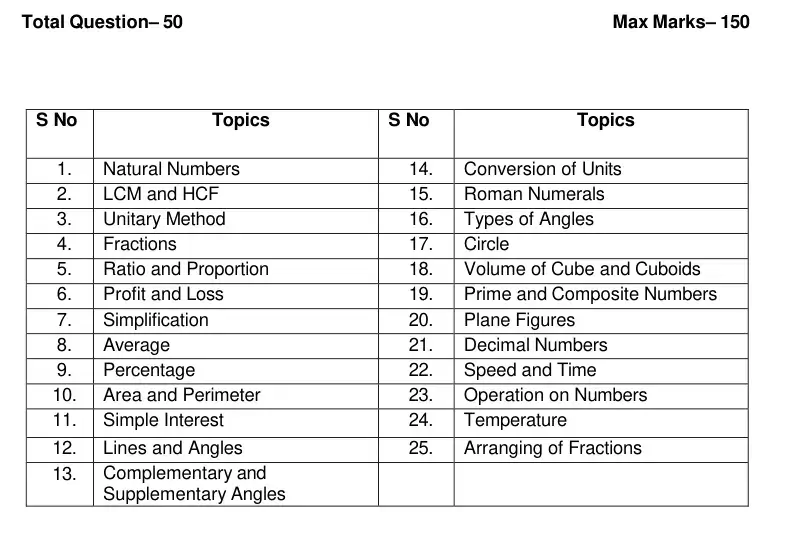
- Total number of questions: 50
- Each question: 3 marks
- Total mark: 150
- Mathematics carries the highest weightage (50%) of marks among the 4 subjects.
| SL | Topic |
|---|---|
| 1 | Natural Numbers |
| 2 | LCM and HCF |
| 3 | Unitary Method |
| 4 | Fractions |
| 5 | Ratio and Proportion |
| 6 | Profit and Loss |
| 7 | Simplification |
| 8 | Average |
| 9 | Percentage |
| 10 | Area and Perimeter |
| 11 | Simple Interest |
| 12 | Lines and Angles |
| 13 | Complementary and Supplementary Angles |
| 14 | Conversion of Units |
| 15 | Roman Numerals |
| 16 | Types of Angles |
| 17 | Circle |
| 18 | Volume of Cube and Cuboids |
| 19 | Prime and Composite Numbers |
| 20 | Plane Figures |
| 21 | Decimal Numbers |
| 22 | Speed and Time |
| 23 | Operation on Numbers |
| 24 | Temperature |
| 25 | Arranging of Fractions |
marker
Sainik School Syllabus for Class 6 English
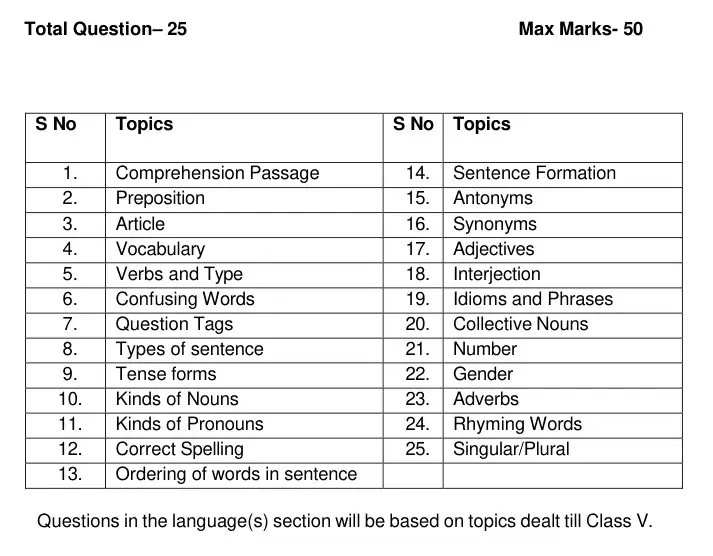
- Total number of questions in English: 25
- Each question of English: 2 marks
- Total mark in English: 50
- In English there are 25 topics listed below. They are form NCERT and CBSE class 5 standard.
| SL | Topic |
|---|---|
| 1 | Comprehension Passage |
| 2 | Preposition |
| 3 | Article |
| 4 | Vocabulary |
| 5 | Verbs and Type |
| 6 | Confusing Words |
| 7 | Question Tags |
| 8 | Types of sentence |
| 9 | Tense forms |
| 10 | Kinds of Nouns |
| 11 | Kinds of Pronouns |
| 12 | Correct Spelling |
| 13 | Ordering of words in sentence |
| 14 | Sentence Formation |
| 15 | Antonyms |
| 16 | Synonyms |
| 17 | Adjectives |
| 18 | Interjection |
| 19 | Idioms and Phrases |
| 20 | Collective Nouns |
| 21 | Number |
| 22 | Gender |
| 23 | Adverbs |
| 24 | Rhyming Words |
| 25 | Singular/Plural |
Sainik School Syllabus for Class 6 General Knowledge
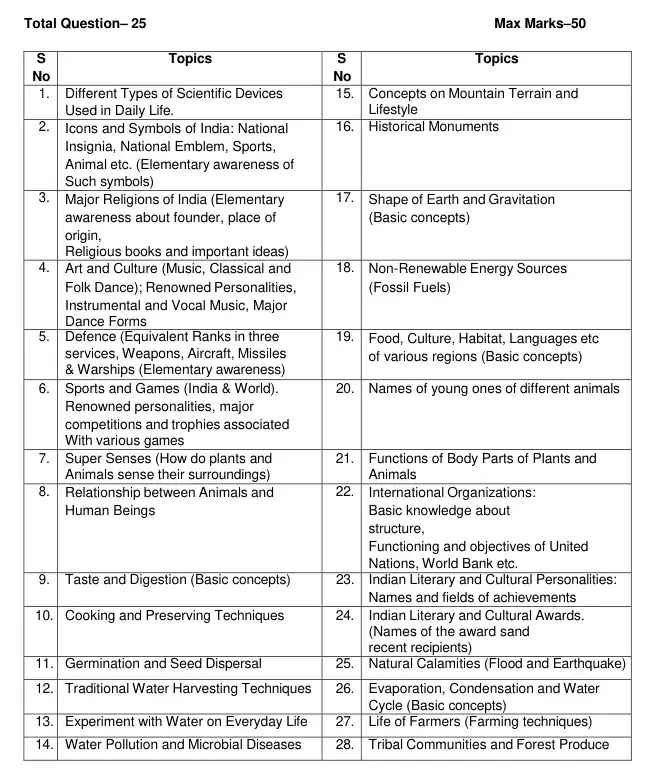
- Total number of questions in GK: 25
- Each question of GK: 2 marks
- Total marks of GK: 50
- In GK there are 28 topics listed below.
| SL | Topic |
|---|---|
| 1 | Different Types of Scientific Devices Used in Daily Life. |
| 2 | Icons and Symbols of India: National Insignia, National Emblem, Sports, Animal etc. (Elementary awareness of Such symbols) |
| 3 | Major Religions of India (Elementary awareness about founder, place of origin, Religious books and important ideas) |
| 4 | Art and Culture (Music, Classical and Folk Dance); Renowned Personalities,Instrumental and Vocal Music, Major Dance Forms |
| 5 | Defence (Equivalent Ranks in three services, Weapons, Aircraft, Missiles & Warships (Elementary awareness) |
| 6 | Sports and Games (India & World). Renowned personalities, major competitions and trophies associated With various games. |
| 7 | Super Senses (How do plants and Animals sense their surroundings) Relationship between Animals and Human Beings |
| 8 | Relationship between Animals and Human Beings |
| 9 | Taste and Digestion (Basic concepts) |
| 10 | Cooking and Preserving Techniques |
| 11 | Germination and Seed Dispersal |
| 12 | Traditional Water Harvesting Techniques |
| 13 | Experiment with Water on Everyday Life |
| 14 | Water Pollution and Microbial Diseases |
| 15 | Concepts on Mountain Terrain and Lifestyle |
| 16 | Historical Monuments |
| 17 | Shape of Earth and Gravitation (Basic concepts) |
| 18 | Non-Renewable Energy Sources (Fossil Fuels) |
| 19 | Food, Culture, Habitat, Languages etc of various regions (Basic concepts) |
| 20 | Names of young ones of different animals |
| 21 | Functions of Body Parts of Plants and Animals |
| 22 | International Organizations: Basic knowledge about structure. |
| 23 | Functioning and objectives of United Nations, World Bank etc. |
| 24 | Indian Literary and Cultural Personalities:Names and fields of achievements |
| 25 | Indian Literary and Cultural Awards. (Names of the award sand recent recipients) |
| 26 | Natural Calamities (Flood and Earthquake) |
| 27 | Evaporation, Condensation and Water Cycle (Basic concepts) |
| 28 | Life of Farmers (Farming techniques) |
| 29 | Tribal Communities and Forest Produce |
Sainik School Syllabus for Class 6 Intelligence
- Total number of questions in Intelligence: 25
- Each question of Intelligence: 2 marks
- Total marks of Intelligence: 50
- Questions on Intelligence will be based on analogies (mathematical & verbal), pattern (spatial and mathematical), classification, visual, logical, reasoning etc.
- No official topic has been provided for Sainik School Intelligence Syllabus for Class 6.
Sainik School Syllabus for Class 9
Sainik School Syllabus for Class 9 Mathematics
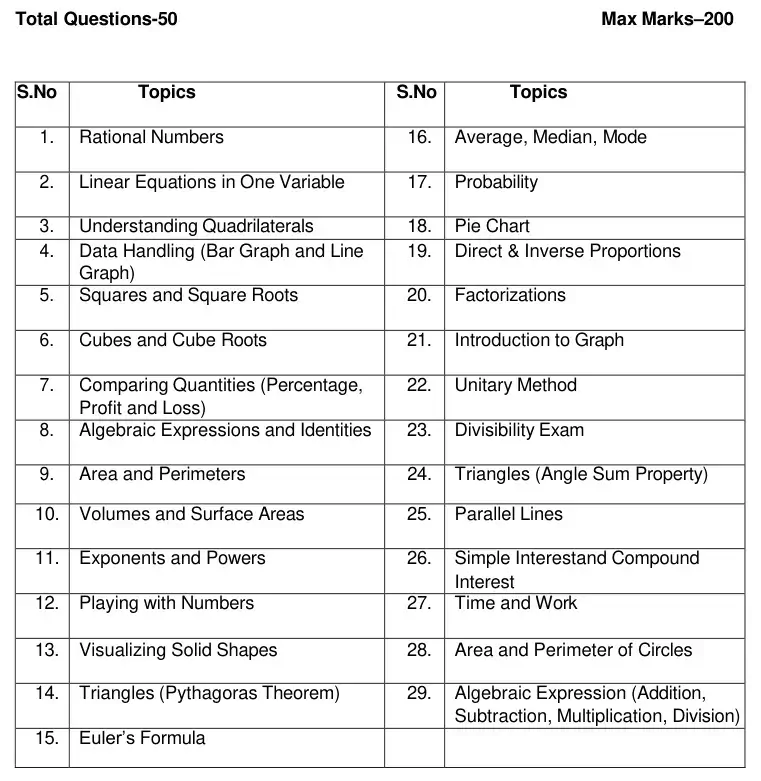
| SL | Topic |
|---|---|
| 1 | Rational Numbers |
| 2 | Linear Equations in One Variable |
| 3 | Understanding Quadrilaterals |
| 4 | Data Handling (Bar Graph and Line Graph) |
| 5 | Squares and Square Roots |
| 6 | Cubes and Cube Roots |
| 7 | Comparing Quantities (Percentage, Profit and Loss) |
| 8 | Algebraic Expressions and Identities |
| 9 | Area and Perimeters |
| 10 | Volumes and Surface Areas |
| 11 | Exponents and Powers |
| 12 | Playing with Numbers |
| 13 | Visualizing Solid Shapes |
| 14 | Triangles (Pythagoras Theorem) |
| 15 | Euler’s Formula |
| 16 | Average, Median, Mode |
| 17 | Probability |
| 18 | Pie Chart |
| 19 | Direct & Inverse Proportions |
| 20 | Factorizations |
| 21 | Introduction to Graph |
| 22 | Unitary Method |
| 23 | Divisibility Exam |
| 24 | Triangles (Angle Sum Property) |
| 25 | Parallel Lines |
| 26 | Simple Interestand Compound Interest |
| 27 | Time and Work |
| 28 | Area and Perimeter of Circles |
| 29 | Algebraic Expression (Addition, Subtraction, Multiplication, Division) |
Sainik School Syllabus for Class 9 English
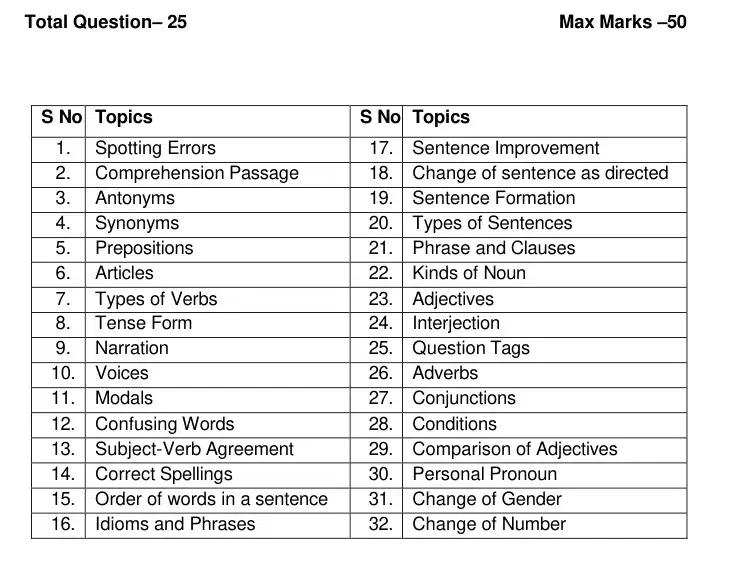
| SL | Topic |
|---|---|
| 1 | Spotting Errors |
| 2 | Comprehension Passage |
| 3 | Antonyms |
| 4 | Synonyms |
| 5 | Prepositions |
| 6 | Articles |
| 7 | Types of Verbs |
| 8 | Tense Form |
| 9 | Narration |
| 10 | Voices |
| 11 | Modals |
| 12 | Confusing Words |
| 13 | Subject-Verb Agreement |
| 14 | Correct Spellings |
| 15 | Order of words in a sentence |
| 16 | Idioms and Phrases |
| 17 | Sentence Improvement |
| 18 | Change of sentence as directed |
| 19 | Sentence Formation |
| 20 | Types of Sentences |
| 21 | Phrase and Clauses |
| 22 | Kinds of Noun |
| 23 | Adjectives |
| 24 | Interjection |
| 25 | Question Tags |
| 26 | Adverbs |
| 27 | Conjunctions |
| 28 | Conditions |
| 29 | Comparison of Adjectives |
| 30 | Personal Pronoun |
| 31 | Change of Gender |
| 32 | Change of Number |
Sainik School Syllabus for Class 9 General Science
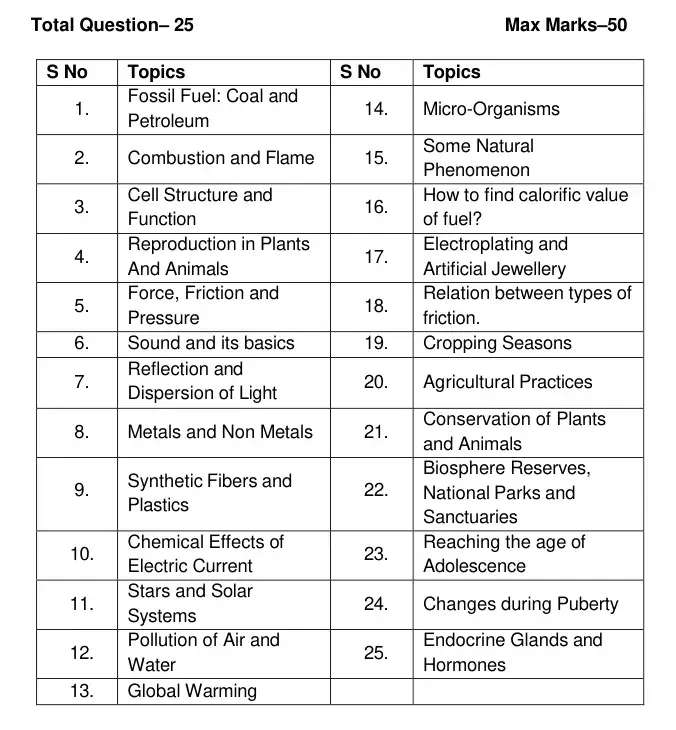
| SL | Topic |
|---|---|
| 1 | Fossil Fuel: Coal and Petroleum |
| 2 | Combustion and Flame |
| 3 | Cell Structure and Function |
| 4 | Reproduction in Plants And Animals |
| 5 | Force, Friction and Pressure |
| 6 | Sound and its basics |
| 7 | Reflection and Dispersion of Light |
| 8 | Metals and Non Metals |
| 9 | Synthetic Fibers and Plastics |
| 10 | Chemical Effects of Electric Current |
| 11 | Stars and Solar Systems |
| 12 | Pollution of Air and Water |
| 13 | Global Warming |
| 14 | Micro-Organisms |
| 15 | Some Natural Phenomenon |
| 16 | How to find calorific value of fuel? |
| 17 | Electroplating and Artificial Jewellery |
| 18 | Relation between types of friction. |
| 19 | Cropping Seasons |
| 20 | Agricultural Practices |
| 21 | Conservation of Plants and Animals |
| 22 | Biosphere Reserves, National Parks and Sanctuaries |
| 23 | Reaching the age of Adolescence |
| 24 | Changes during Puberty |
| 25 | Endocrine Glands and Hormones |
Sainik School Syllabus for Class 9 Social Science
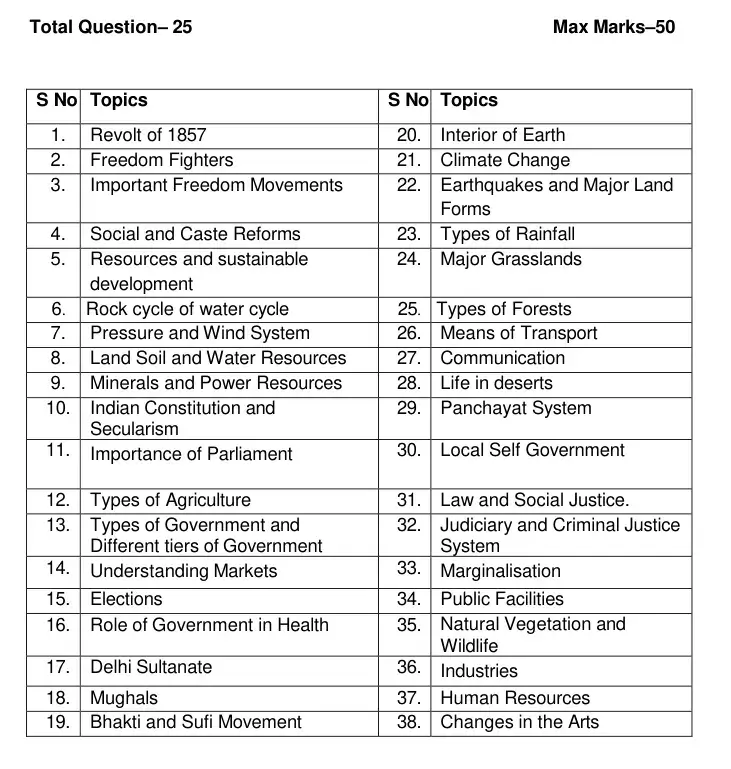
| SL | Topic |
|---|---|
| 1 | Revolt of 1857 |
| 2 | Freedom Fighters |
| 3 | Important Freedom Movements |
| 4 | Social and Caste Reforms |
| 5 | Resources and sustainable development |
| 6 | Rock cycle of water cycle |
| 7 | Pressure and Wind System |
| 8 | Land Soil and Water Resources |
| 9 | Minerals and Power Resources |
| 10 | Indian Constitution and Secularism |
| 11 | Importance of Parliament |
| 12 | Types of Agriculture |
| 13 | Types of Government and Different tiers of Government |
| 14 | Understanding Markets |
| 15 | Elections |
| 16 | Role of Government in Health |
| 17 | Delhi Sultanate |
| 18 | Mughals |
| 19 | Bhakti and Sufi Movement |
| 20 | Interior of Earth |
| 21 | Climate Change |
| 22 | Earthquakes and Major Land Forms |
| 23 | Types of Rainfall |
| 24 | Major Grasslands |
| 25 | Types of Forests |
| 26 | Means of Transport |
| 27 | Communication |
| 28 | Life in deserts |
| 29 | Panchayat System |
| 30 | Local Self Government |
| 31 | Law and Social Justice. |
| 32 | Judiciary and Criminal Justice System |
| 33 | Marginalisation |
| 34 | Public Facilities |
| 35 | Natural Vegetation and Wildlife |
| 36 | Industries |
| 37 | Human Resources |
| 38 | Changes in the Arts |